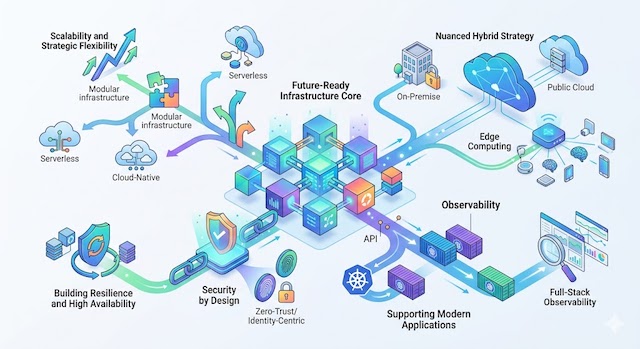
As technology evolves at an unprecedented pace, IT infrastructure must do more than support day-to-day operations. It must enable growth, innovation, and resilience.
A future-ready IT infrastructure is flexible, secure, and designed to adapt as business needs change—without constant rework or disruption.
1. Designing for Scalability and Strategic Flexibility
Future-ready infrastructure scales with the business, but scalability does not require a singular architectural path.
Key principles include:
- Modular Infrastructure: Using loosely coupled systems that can reside in different environments.
- Architectural Choice: Utilizing Serverless or Cloud-Native models where they drive efficiency, while maintaining high-performance dedicated environments for core legacy workloads.
- On-demand Resource Provisioning: Ensuring that the platform—wherever it sits—can adapt to variable workloads.
2. The Nuanced Hybrid Strategy: On-Premise, Cloud, and Edge
Modern infrastructure extends beyond the data center, but it must be grounded in the nature of the business. A successful infrastructure depends on a critical architectural balance: choosing the right environment based on where the information originates and where the decisions must be made.
Infrastructure is no longer a choice between On-Premise or Cloud; it is a strategic combination:
- On-Premise: Retaining control for high-security, sensitive data, or legacy systems that require direct oversight.
- Public/Private Cloud: Leveraging the elastic compute of the cloud for non-sensitive, high-scale applications.
- On-Edge: Deploying intelligence at the source of data to minimize latency.
3. Edge Computing: Intelligence at the Source
To be truly future-ready, infrastructure must account for the rise of distributed data. Edge Computing moves processing closer to where information originates to improve response times and save bandwidth.
- Reduced Latency: Critical for real-time decision-making where sending data to a central cloud is too slow.
- Operational Continuity: Allowing local systems to function even if core cloud connectivity is interrupted.
- Data Filtering: Processing at the edge to send only high-value, anonymized insights back to the core.
4. Building Resilience and High Availability
Downtime directly impacts revenue and reputation.
Future-ready infrastructure includes:
- Redundant systems and failover mechanisms across hybrid locations.
- Automated backup and geo-redundant disaster recovery.
- Proactive monitoring and business continuity planning.
5. Security by Design: Protecting the Distributed Core
Security must be embedded, not bolted on. In a hybrid environment, the perimeter is porous, requiring a shift in strategy.
Best practices include:
- Zero-Trust Network Architectures: Ensuring every access request is verified regardless of where it originates.
- Identity-Centric Access Controls: Focusing on the user and the role rather than the network location.
- Data Sovereignty: Designing environments that comply with regional regulations for data storage and residency.
6. Supporting Modern Application Architectures
Applications define infrastructure needs.
Future-ready environments support:
- Containerization (Kubernetes): Ensuring portability so workloads can move seamlessly between on-premise and cloud.
- API-Driven Systems: Building for agility and rapid integration with partner ecosystems.
- Platform Engineering: Creating a consistent developer experience across disparate infrastructure types.
7. Enabling Observability and Performance Management
Visibility is critical when dealing with complex hybrid environments.
Organizations should implement:
- Full-Stack Observability: Centralized logging that bridges the gap between on-premise and cloud metrics.
- Real-Time Performance Monitoring: Detecting anomalies across the entire edge-to-cloud spectrum.
- Capacity Optimization: Balancing workloads to maximize performance while controlling costs.
8. The Role of ACUITOLOGY in Infrastructure Strategy
Infrastructure transformation requires a deep understanding of both legacy banking systems and modern AI-ready architectures.
ACUITOLOGY helps organizations:
- Assess Nature of Business: Determining the specific compliance, security, and performance needs.
- Architect Hybrid Solutions: Designing the right mix of on-premise, cloud, and edge.
- Modernization Roadmaps: Managing the transition from legacy debt to a future-ready foundation.
Reflections
A future-ready IT infrastructure is not built for today—it is built for continuous change.
Organizations that invest strategically in infrastructure, focusing on the specific origin of their data and the location of their decisions, gain the agility and resilience needed to thrive in a digital-first world.
“Infrastructure should never slow the business down. When engineered with a focus on workload placement and business context, it becomes an engine for innovation and growth.”