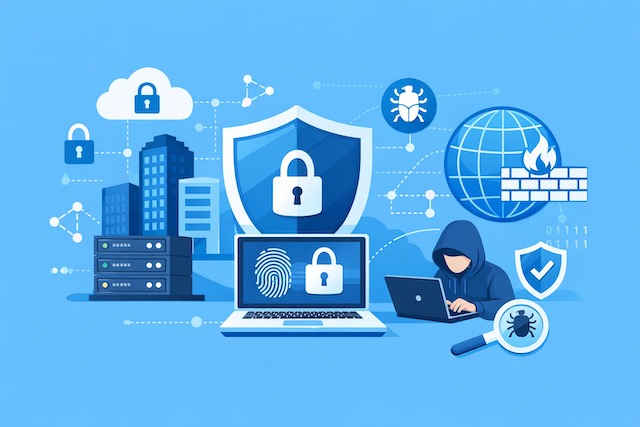
Cybersecurity is no longer just an IT concern—it is a core business priority. As organizations become more digital and data-driven, cybersecurity must never be an afterthought; it must be engineered into the foundation of every business process from the start.
In today’s landscape, implementing strong security is essential to protect not just systems, but the very survival of the enterprise.
1. Embracing the Zero Trust Model
The traditional “castle and moat” approach to security is dead. Modern businesses must adopt a Zero Trust framework, which operates on the principle of “Never Trust, Always Verify.”
This means every access request, whether it originates from inside or outside the network, must be fully authenticated, authorized, and encrypted. By implementing Zero Trust, organizations ensure that a single compromised device cannot lead to a total system breach.
2. Proportionate Protection: Data Classification Standards
Following international best practices such as CISSP and ISO 27001, security policies must be commensurate with the information being protected. Not all data is equal, and a mature strategy requires classifying information into tiers to apply the appropriate level of rigor:
- Public: Information intended for general consumption.
- Private: Internal business data not for public release.
- Confidential: Sensitive info (e.g., payroll, strategy) requiring specific permissions.
- Restricted: Critical assets, including Authentication Data (Passwords) and PII, requiring the highest level of encryption, vaulting, and strict access logging.
3. Strengthening the Weakest Link
Technical defenses are vital, but good cybersecurity is only as strong as its weakest link. Frequently, that link is the human element.
To mitigate this, businesses should:
- Foster a culture where security is everyone’s responsibility.
- Provide continuous, engaging security awareness training.
- Conduct regular phishing simulations to keep employees vigilant.
4. Securing the AI Frontier
The rapid rise of AI Adoption introduces new risks that require a dedicated security focus. Whether it is preventing sensitive data from leaking into public LLMs or protecting AI models from prompt injection attacks, security must evolve in parallel with the tech stack.
Proactive measures, such as secure gateways and rigorous data-vetting protocols, ensure that AI remains a tool for growth rather than a backdoor for threats.
5. Robust Identity, Access Management, and Operational Control
Unauthorized access remains a leading cause of breaches. Implementing rigorous controls prevents single-point failures through:
- Least-Privilege Access: Ensuring users only have permissions necessary for their specific role.
- Segregation of Duties (4-Eye Principle): Critical operations—such as financial transfers or system configuration changes—should require a Maker-Checker workflow. This ensures no single individual has the power to execute sensitive tasks end-to-end without oversight.
- Multi-Factor Authentication (MFA): Mandatory for all entry points.
6. Proactive Monitoring and Incident Response
Prevention alone is not enough. A resilient strategy assumes a breach will eventually occur and prepares accordingly.
- Continuous Monitoring: Real-time visibility into system behavior.
- Defined Playbooks: Ensuring teams know exactly what to do when a threat is detected.
- Business Continuity: Storing backups securely and testing restoration regularly to ensure operational resilience.
7. Governance, Risk, and Compliance (GRC)
Good governance ensures that security is aligned with business objectives. For industries like finance and healthcare, compliance is the baseline. Building upon that baseline creates a robust risk management framework that protects brand reputation and long-term viability.
8. The Role of ACUITOLOGY in Cybersecurity Maturity
Cybersecurity is complex and constantly evolving. It should never be a “bolt-on” addition.
Our Acuitologists help organizations:
- Assess current security posture against the “Weakest Link” principle.
- Architect Zero Trust environments from the ground up.
- Implement Segregation of Duties and Maker-Checker protocols for operational excellence.
- Align data classification with international CISSP standards.
Reflections
Cybersecurity is not about eliminating risk—it’s about managing risk intelligently. It is an ongoing commitment to protecting what matters most.
When security is integrated from the start, it becomes a growth enabler, allowing the business to innovate and scale with confidence.
“Cybersecurity isn’t a one-time project; it is a business evolution. When protections are commensurate with the data and duties are properly segregated, trust becomes your greatest asset.”