Legacy systems were once reliable foundations for business operations. Today, they are often viewed as barriers to growth, but at Acuitology, we believe that replacing a system is not always the only—or even the right—approach.
Modernization is about finding the specific path that balances business risk, cost, and agility. Understanding the true cost of legacy systems is the first step, but choosing the right strategy is how you win.
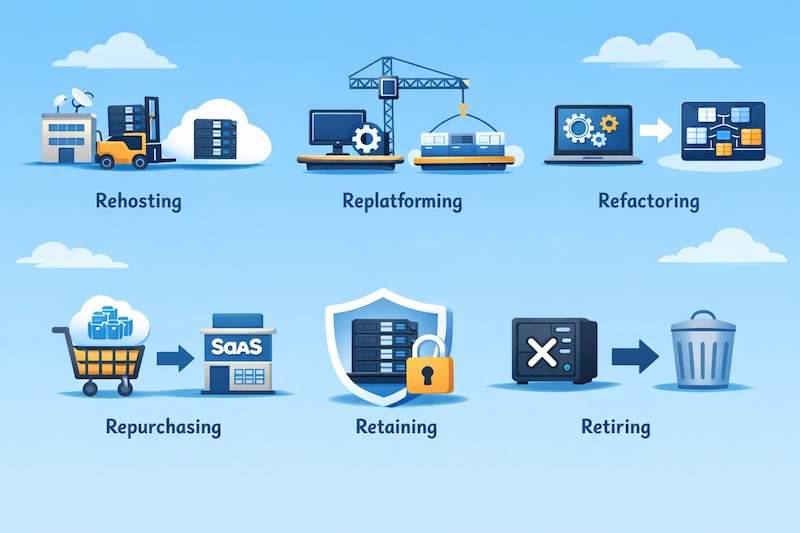
The 6 Rs of Strategic Modernization
Instead of a “rip and replace” mindset, our Acuitologists evaluate every application in your portfolio against six distinct strategies to ensure the solution matches the business need:
1. Rehosting (Lift and Shift)
This involves moving an application to a modern infrastructure (usually the cloud) without modifying its code. It is the fastest way to reduce hardware debt.
- Example: Moving a legacy accounting system from a physical on-premise server to a Cloud Virtual Machine. It reduces data center overhead without the risk of code changes.
2. Replatforming (Lift and Reshape)
Optimization is achieved without changing the core architecture. You swap out specific components for managed services to reduce the burden of manual management.
- Example: Moving an on-premise database to a managed service like AWS RDS or Supabase. The app remains the same, but you no longer manage the OS or backups.
3. Refactoring / Re-architecting
Redeveloping application components using cloud-native features. This is reserved for core systems that require high scalability and long-term agility.
- Example: Transitioning a monolithic banking application into Microservices using Serverless functions to enable rapid updates.
4. Repurchasing (Drop and Shop)
Moving from a traditional perpetual license to a Software-as-a-Service (SaaS) model.
- Example: Moving from an internally hosted CRM to a specialized platform like Salesforce or PharmaDigits. The internal architecture is discarded in favor of a vendor-managed service.
5. Retaining (Keep for Now)
Keeping a core business application as it is. Some systems are too critical to move immediately or have a limited remaining lifespan that doesn’t justify the investment.
- Example: A legacy ERP scheduled for decommissioning in 18 months. We retain it to focus the modernization budget on higher-impact areas.
6. Retiring
Identifying and removing applications that are no longer needed. Modernization often begins by identifying redundant systems that no longer serve a purpose.
- Example: Shutting down an old reporting tool after its data has been successfully integrated into a modern Data Warehouse.
Why Modernization is Critical Today
Even with a phased approach, ignoring legacy debt carries significant strategic risks:
- Rising Maintenance Costs: Specialized skills for aging languages are becoming rare and expensive.
- Security and Compliance Gaps: Legacy systems often lack Zero Trust capabilities and no longer receive critical security patches.
- Incompatibility with AI: Disconnected systems prevent you from leveraging modern AI and Analytics for data-driven decision-making.
The Role of ACUITOLOGY in Strategic Modernization
Legacy transformation is complex. Our Acuitologists help you navigate this transition by:
- Portfolio Assessment: Determining which of the 6 Rs applies to each application.
- Risk Mitigation: Planning phased rollouts that ensure business continuity.
- ROI Alignment: Prioritizing changes that offer the fastest return on operational efficiency.
Reflections
Legacy systems are not just technical challenges—they are strategic opportunities. By moving away from an “all or nothing” mindset, organizations can gain agility and security while respecting their existing investments.
“Modernization isn’t just about the newest technology; it’s about the right-fit strategy. Every year a legacy system stays unassessed, it costs you more in lost opportunity.”