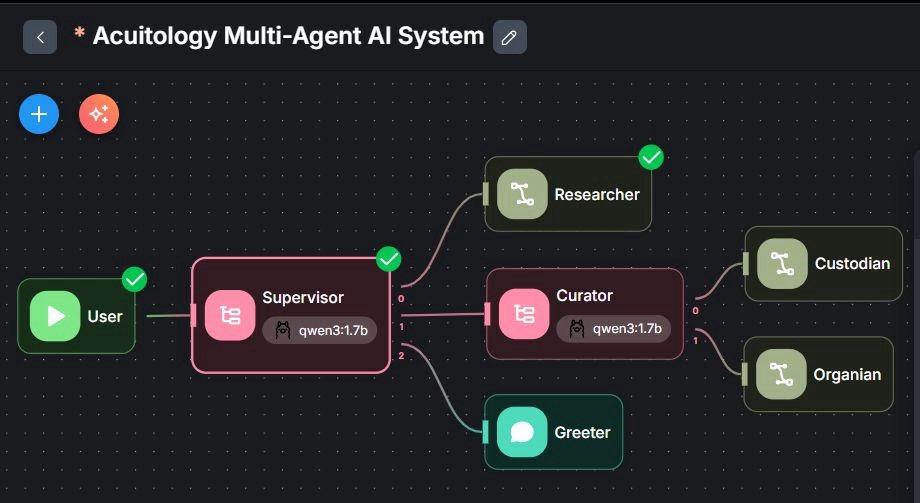
At Acuitology, we focus on continuous experimentation with new technologies to bridge the gap between technical innovation and measurable business value. We recently built our very first Multi-Agent AI system 🤖 on a LangChain 🔗 framework, utilizing a nested Supervisor-Worker pattern.
The Architecture: Supervisor & Specialized Workers
🧠 The Supervisor is an autonomous agent that analyzes user intent and intelligently assigns tasks to one of the specialized workers: Researcher, Curator, or Greeter.
🌐 The Researcher is a Tool Agent with internet access to answer any queries on the ACUITOLOGY website.
📚 The Curator is a Conversational QA hybrid Agentic RAG that handles queries on a private knowledge base. It appropriately delegates and combines output as necessary from its own workers:
- 🧮 The Custodian: A Vector RAG for similarity searches on ACUITOLOGY’s product catalog.
- 🕸️ The Organian: A Graph RAG for answering queries on organizational structure, reporting lines, and product ownership.
🤝 The Greeter’s job is to simply keep users engaged if their queries do not fall into either of the other categories.
The Open-Source Tech Stack
We primarily chose open-source technologies, as they are often needed for quick experimentation 🚀 and idea validation under constrained environments. The core technologies utilized were:
- FlowiseAI: A low-code platform.
- Ollama: For local hosting of LLMs & SLMs.
- Qwen3:1.7b: For Supervisor nodes.
- Gemma3-tools: For the Tool Agent.
- Gemma2:2b: For text-to-Cypher queries.
- All-MiniLM: For vector embeddings.
- Gemma3:1b: For all other chatflows.
- LangChain library: For recursive character text splitting.
- FAISS: For in-memory ANN-based semantic search.
- Neo4j: For knowledge graphs.
- Arize AI: For LLM observability.
- Docker, Inc: For running containerized applications with a local shared network.
Reflections
We observed that the role prompts, feedback loops, temperature control, and the type of LLMs used (number of parameters, tooling, thinking, and embedding capabilities, etc.) significantly impact the quality and performance of the Agentic AI system’s output.
“This milestone marks the beginning of our deeper journey into the Agentic AI space. At Acuitology, we are committed to moving beyond experimentation, translating these technical insights into robust, scalable solutions that drive purposeful business transformation for our clients.”